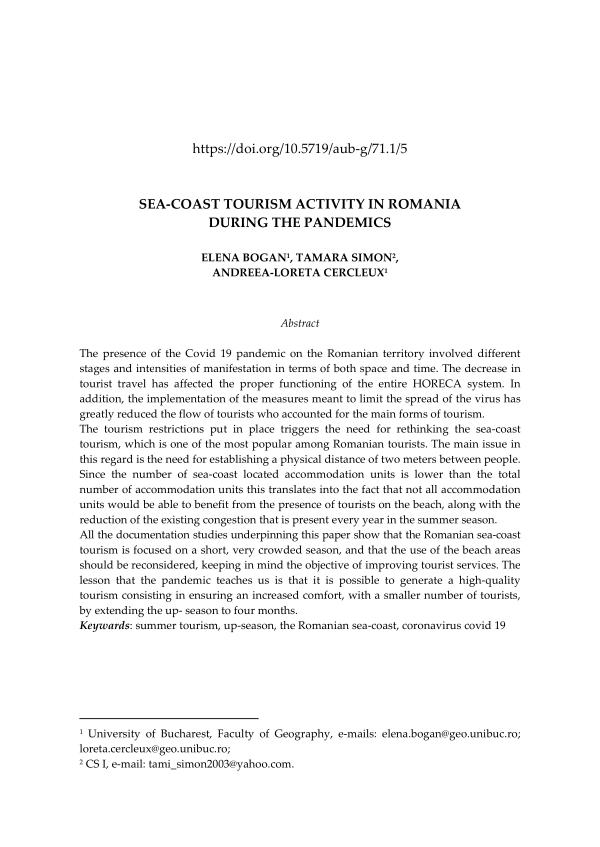
Sea-coast Tourism Activity in Romania during the Pandemics
DOI:
https://doi.org/10.5719/aub-g/71.1/5Keywords:
summer tourism, up-season, the Romanian sea-coast, coronavirus covid 19Abstract
The presence of the Covid 19 pandemic on the Romanian territory involved different stages and intensities of manifestation in terms of both space and time. The decrease in tourist travel has affected the proper functioning of the entire HORECA system. In addition, the implementation of the measures meant to limit the spread of the virus has greatly reduced the flow of tourists who accounted for the main forms of tourism. The tourism restrictions put in place triggers the need for rethinking the sea-coast tourism, which is one of the most popular among Romanian tourists. The main issue in this regard is the need for establishing a physical distance of two meters between people. Since the number of sea-coast located accommodation units is lower than the total number of accommodation units this translates into the fact that not all accommodation units would be able to benefit from the presence of tourists on the beach, along with the reduction of the existing congestion that is present every year in the summer season. All the documentation studies underpinning this paper show that the Romanian sea-coast tourism is focused on a short, very crowded season, and that the use of the beach areas should be reconsidered, keeping in mind the objective of improving tourist services. The lesson that the pandemic teaches us is that it is possible to generate a high-quality tourism consisting in ensuring an increased comfort, with a smaller number of tourists, by extending the up- season to four months.References
Bogan, E, Simon, T., Cândea, M., 2021, Patrimoniul turistic al României, Editura Universitară, Bucharest.
Botero, C.M.; Cabrera, J.A.; Mercadé, S.; Bombana, B., 2020, Análisis general y recomendaciones para afrontar la crisis de la COVID-19 en el turismo de sol y playa. In El Turismo de sol y Playa en el Contexto de la COVID-19. Escenarios y Recomendaciones; Botero, C.M., Cabrera, J.A., Mercadé, S., Bombana, B., Eds.; Red Iberoamericana Proplayas: Santa Marta, Colombia, pp. 10–31.
Burke, L., Kura Y., Kassem, K., Revenga, C., Spalding, M., McAllister, D., 2001, Pilot analysis of global ecosystems: coastal ecosystems. Washington, DC, USA: World Resources Institute.
Collins-Kreiner, N., Ram, Y., 2021, National tourism strategies during the Covid-19 pandemic. Annals of Tourism Research, Volume 89.
Dobson, S. (Ed.). 2003, Edited proceedings from the workshop "Policy Directions for Coastal Tourism". Burnaby, BC, Canada: Simon Fraser University.
Garrod, B., Wilson, J. C. (Eds.). 2003. Marine ecotourism: issues and experiences. Sydney, Australia: Channel View Publications.
Karabuluta, G., Huseyin, B.M., Demirc, E., Dokerd, A.C., 2020, How pandemics affect tourism: International evidence. Annals of Tourism Research, Volume 84.
Kline, J. D. 2001, Tourism and natural resource management: a general overview of research and issues. Washington, DC, USA: United States Department of Agriculture.
Yunis, E. 2006, Tourism in SIDS: a key factor for economic, social and environmental sustainability. London, UK: World Tourism Organization.
Zielinski, S., Botero, CM. 2020, Beach Tourism in Times of COVID-19 Pandemic: Critical Issues, Knowledge Gaps and Research Opportunities. International Journal of Environmental Research and Public Health, 17(19):7288.
Government Decision no. 357/2018 on the approval of the List of strategic investment projects to be prepared and assigned in public-private partnership by the National Commission for Strategy and Forecast, published in the Official Gazette, Issue 466, of 6 June 2018 (Part I).
Government Decision no. 394/18 May 2020 on the declaration of the state of alert and the measures applied during it to prevent and combat the effects of the COVID-19 pandemic, published in the Official Gazette, Issue 410, of 18 May 2020.
Detente Consultants (2009), Master Plan for the Development of Spa Tourism in Romania of the Ministry of Regional Development and Tourism.
National Institute for Research Development in Tourism INCDT (2009), Study on the development of tourism development strategy in the southern part of the Romanian coast, including resorts and territorial and administrative division included in Eforie, Costinești, Mangalia and Limanu.
National Institute of Statistics;http://statistici.insse.ro:8077/tempo-online/#/pages/tables/insse-table.
National Institute of Statistics, brochure National Regional Accounts 2012– 2016, published in 2019.
Ministry of Tourism, World Tourism Organization (2007) Master Plan for the Development of Romanian National Tourism between 2007 and 2026.
Integrated Strategy for Sustainable Tourism Development in Constanța County, 2019-2028, 2019, Phase I, Diagnostic Analysis regarding the development of tourism in Constanța County, National Institute for Research and Development in Tourism, Bucharest.
BS MARSPLAN BS, Cross-Border Maritime Spatial Plan for the Black-Sea; MARSPLAN – BS and MARSPLAN – BS II,[http://www.marsplan.ro/ro/](http://www.marsplan.ro/ro/)amenajarea-spa%C8%9Biului-maritim-%E2%80%93-marea-neagr%C4% 83.html.
Master Plan on the protection and rehabilitation of the coastal area, "Romanian Waters" National Administration / Administrația Națională Apele Române;http://www.rowater.ro/dobrogea/MasterPlanprivindProte%C8%9BiaReabilitareaZonei/MasterPlan.pdf.
https://www.mlpda.ro/ userfiles/PATZ_zona_costiera_fazaIII.pdf-p1-280, p 1-215
Downloads
Published
Issue
Section
License
Copyright (c) 2022 Annals of Bucharest University - Geographical Series

This work is licensed under a Creative Commons Attribution-NonCommercial-NoDerivatives 4.0 International License.