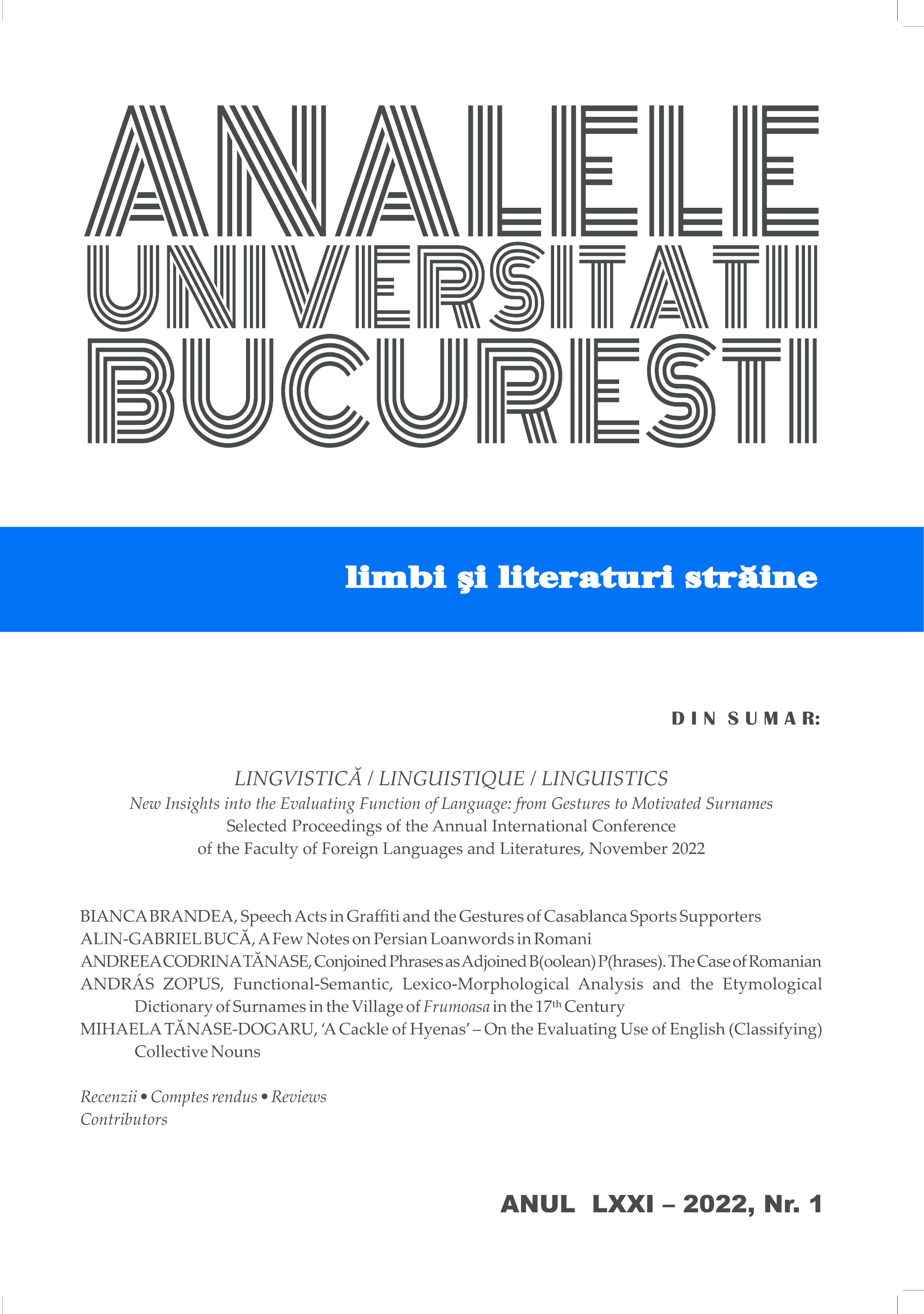
Vol. 71 No. 1 (2022): The Annals of the University of Bucharest”, Foreign Languages and Literatures. Volume 71, No.1
Articles
-
Speech Acts in Graffiti and Gesture of the Sports Supporters from Casablanca
Abstract
The present paper applies speech acts theories on specific interactions and other public activities performed inside and outside the Moroccan stadia by the sports supporters from Casablanca. We will mainly focus on the non-verbal types of interactions, where their symbolic actions and graphic manifestations acquire the relevant roles implied in the accomplishment of speech acts. Most of the sports supporters' attitudes towards each other's groups are offensive, given the fact that each group attempts to assert its domination and intimidate and/or challenge their rivals. Additionally, other attitudes are intended to indicate their ambitions for freedom of expression, especially on the stadia. The means of expression approached in the present paper are graffiti and gestures. -
A Few Notes on Persian Loanwords in Romani
Abstract
The Iranian lexicon in Romani has not been studied in depth from a more comprehensive perspective and multiple challenges arise when trying to identify direct Persian loans. Indo-Iranian and Indo-Aryan share a substantial number of cognates and most lexicographic works with etymological glosses generally give precedence to the latter. Mediation via Turkish or another Balkan L2 needs to be evaluated before weighing the likelihood of a direct Persian origin, and a fine-tuned phonological analysis needs to be carried out. In some cases, comparison with the Lomavren corpus can provide valuable clues for the elucidation of murkier etymological pathways. A sound survey of dialectal isoglosses is also required for a clearer picture of the underlying lexical borrowing processes. The paper provides a set of sample cases glossed using this approach, which could form the basis of more extensive future research. -
Conjoined Phrases as Adjoined B(oolean) P(hrases). The Case of Romanian
Abstract
The aim of this paper is twofold. On the one hand it is meant to provide an overview of Kayne's (1994) antisymmetry theory and of Munn's (1993) Adjoined B(oolean) P(hrases) Theory in regard to conjoined phrases, as to verify the preferable way of approaching asymmetric coordination. The focus point of this section is presenting the advantages of taking conjoined phrases as adjoined BPs (the conjunction and second conjoin seen as part of a maximal projection) and checking if they hold true in the Romanian language. On the other hand, this section discusses the disadvantages brought up in the literature and possible solutions that have been proposed for each. -
Functional-Semantic, Lexico-Morphological Analysis and the Etymological Dictionary of Surnames in the Village of Frumoasa in the 17th Century
Abstract
This paper lists all the 17th century surnames that are related to Frumoasa1 , according to currently available sources. As a result of the research, readers will become aware of the significance of these names, and they will be able to compare their different spellings and comprehend the diversity of family names in Frumoasa. Exploring the historical onomastic material also provides an opportunity for a contrastive study of today's onomastic material, and therefore, can offer valuable data to those involved in onomastic or genealogical research. -
‘A Cackle of Hyenas’ – On the Evaluating Use of English (Classifying) Collective Nouns
Abstract
The paper shows that collective nouns in English, i.e._a crowd of people, a cackle of hyenas, an ostentation of peacocks_a.s.o., fall into two categories. The first category is represented by quantifier-like nouns, i.e._group, number_, while the second category is illustrated by evaluating nouns, i.e._cackle, ostentation_. The category of evaluating collective nouns is mainly used with animal groups and bears a striking similarity to what has been called the evaluating use of size nouns (see Brems 2010, Tănase-Dogaru 2022). In the evaluating use, the nominal that occupies the first position in the structure simply picks up some of the characteristic lexical features of the second nominal.