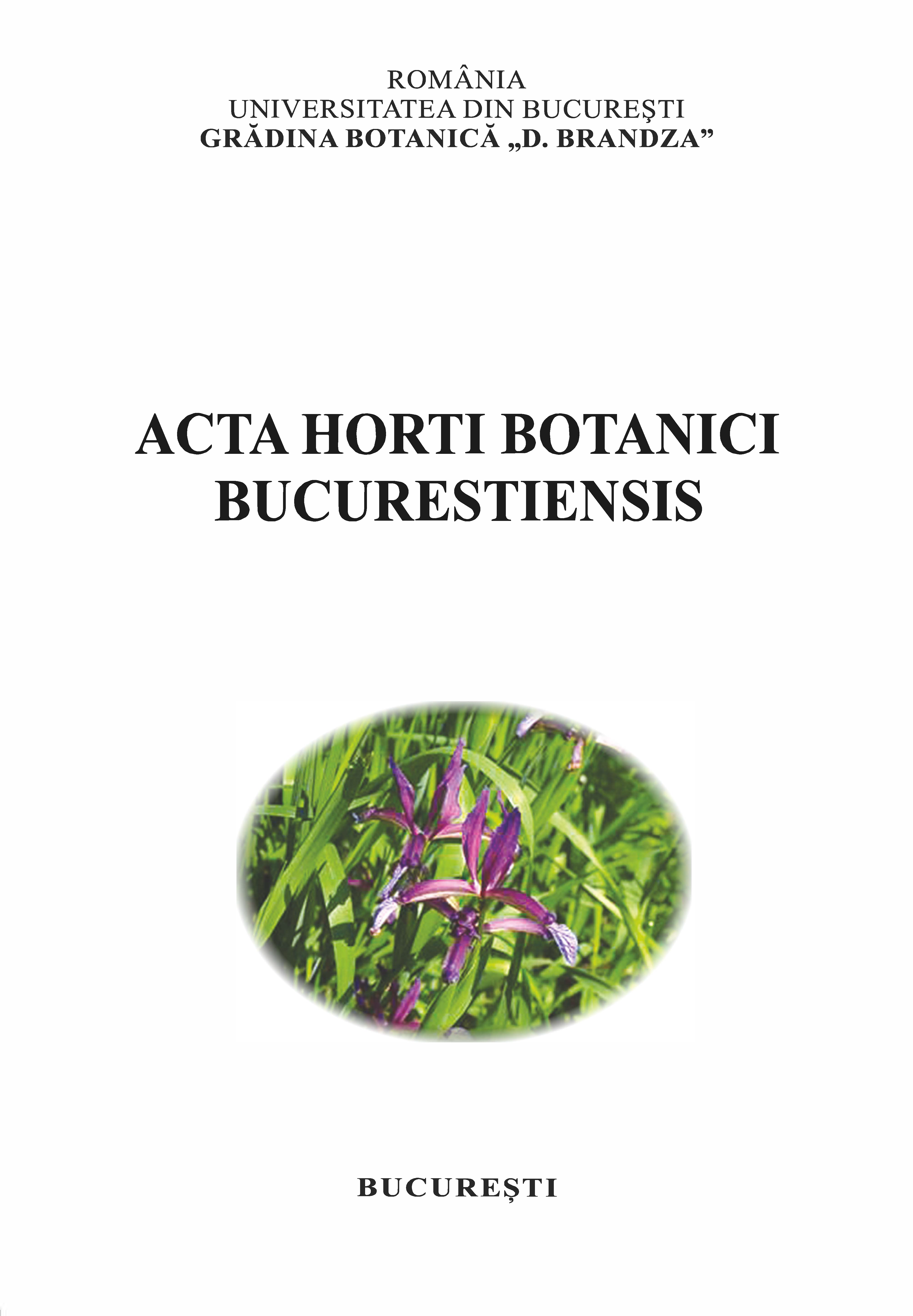
About the Journal
Acta Horti Botanici Bucurestiensis is a scientific international journal founded in 1959, published once a year. The journal publishes original papers focused on aspects of plant anatomy and morphology, systematic botany, plant, algae and fungi biodiversity, plant physiology and biochemistry, plant genetics and biotechnology, plant pathology, horticulture.
Current Issue
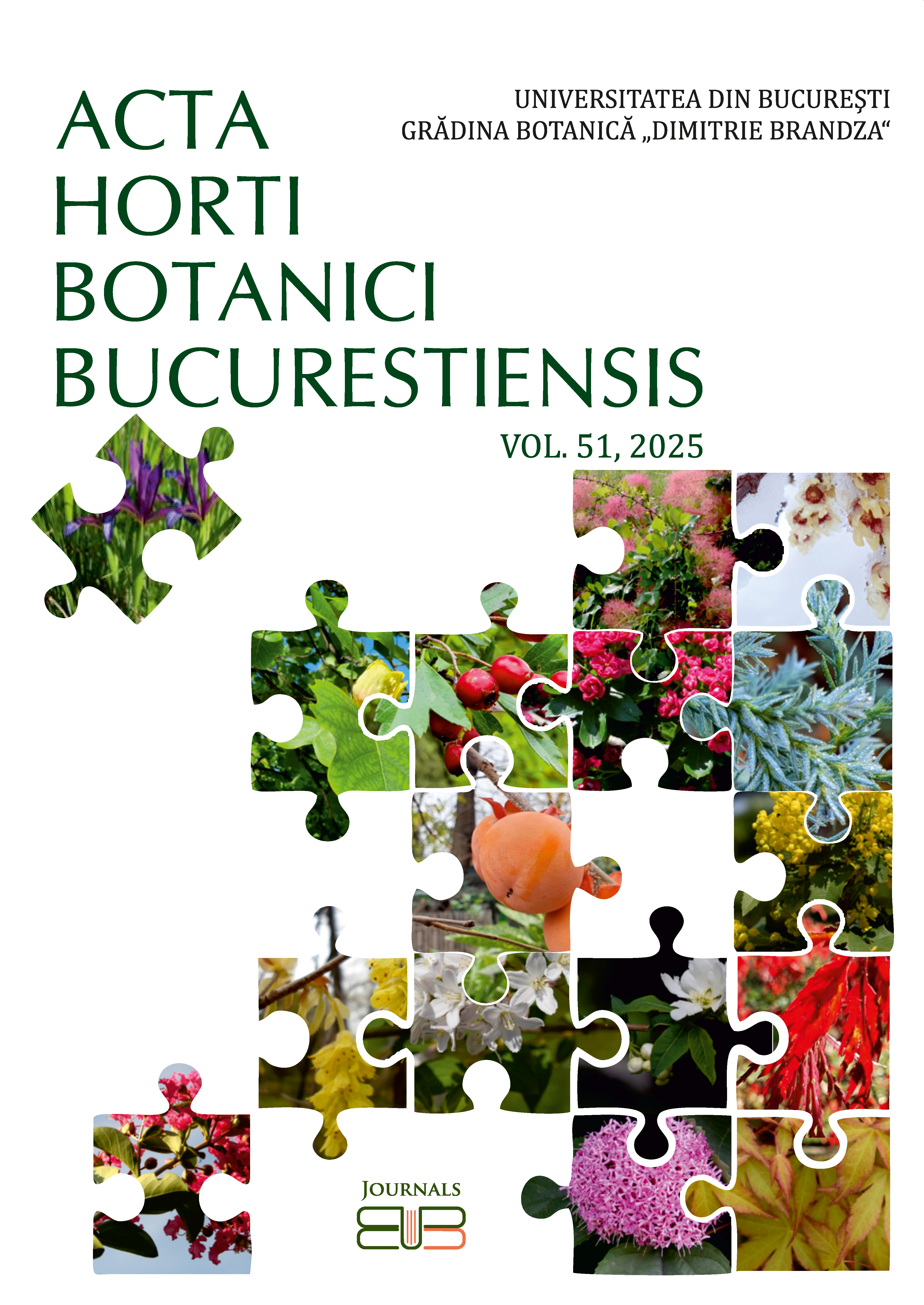
The journal publishes original papers focused on aspects of plant anatomy and morphology, systematic botany, plant, algae and fungi diversity, plant physiology and biochemistry, plant genetics and biotechnology, plant pathology, horticulture.
Full Issue
Articles
-
BUILDING FOR PLANT CONSERVATION – A CASE STUDY FROM BUCHAREST, ROMANIA
Abstract
In the big and crowded cities of the world, a large number of rooftops have been transformed into living green areas, small or large, extensive, semi-intensive or intensive, with different uses in the lives of citizens. This contribution presents an example of a small, intensive rooftop garden, created on the rooftop terrace of a private house, in the city of Bucharest, with the aim of conserving plants and reconnecting people with nature. The terrace, located at a height of 10 m, on an area of 40 sqm, was built in 2011, using the ZinCo Technology, which ensures high water storage and a variety of substrates and depths. The current floristic composition (2023) includes 55 taxa of vascular plants (51 non-native species and 4 native species), belonging to 31 families of angiosperms and 3 families of gymnosperms: annual plants, geophytes, perennial herbaceous plants, subshrubs, shrubs, and trees. The criteria used in the selection and grouping of plants pertain to ecological preferences, tolerance to stressful environmental factors, plant importance, growth rate, low maintenance, spatial and seasonal diversity. The results provide an overview of the green rooftop system technology, the development of taxa introduced during a decade since the establishment of the garden and highlight the plants and combinations of plants suitable for local conditions.
-
TAXONOMIC AND PRESERVATION ASSESSMENT OF THE IRIDACEAE COLLECTION HOUSED IN THE HERBARIUM OF THE BOTANIC GARDEN “D. BRANDZA” (BUC)
Abstract
This study provides a detailed overview of the Iridaceae family housed within the Herbarium of the "D. Brandza" Botanic Garden, University of Bucharest (BUC). As part of an ongoing digitization initiative, the collection was meticulously inventoried, and the label data was integrated into the herbarium database. Our analysis reveals a collection of 392 specimens, comprising 62 species and infraspecific taxa within 15 genera, out of which a notable mention is the community-interest species Iris aphylla subsp. hungarica. This collection includes native Romanian flora, as well as specimens collected from various parts of the world by 73 collectors, between 1908 and 2018.
-
FLORISTIC DIVERSITY AND CONSERVATION VALUE OF BUCHAREST’S HISTORICAL PARKS
Abstract
In the context in which the flora of Bucharest has been insufficiently studied in recent decades, and the current urban dynamics profoundly influence the vegetation, the present study contributes to updating the knowledge on urban plant diversity. The research is part of the project "Urban flora and its characteristics in Bucharest and surroundings" (ICUB – Grants for Young Researchers) carried out between 2023 and 2024 and targets five representative historical parks: Carol I, Cișmigiu, Kiseleff, King Michael I of Romania and Cotroceni. The floristic inventory, carried out between March and September 2023 (for Cotroceni in 2025), allowed the identification of 555 taxa of vascular plants, both spontaneous and cultivated. The proportion of autochtonous species (54%) slightly exceeds the allochthonous component, indicating the maintenance of a significant autochtonous flora within the city. Among the autochtonous species characteristic of the original forest areas are Corydalis solida, Allium ursinum, Alliaria petiolata, Ranunculus ficaria and Viola odorata, and among those with conservation value, Cephalanthera damasonium stands out, spontaneously present in King Michael I Park of Romania. In parallel, 46 invasive alien species were identified, including Ailanthus altissima, Acer negundo, Phytolacca americana, Reynoutria japonica, Reynoutria × bohemica and Ambrosia artemisiifolia. The results highlight the character of historical parks as urban biodiversity hotspots, which, in addition to their aesthetic and recreational role, can be capitalized on for environmental education and public awareness activities. The implementation of adaptive landscape management, oriented towards the conservation of autochtonous species and the control of invasive ones, is essential for maintaining the ecological balance and heritage value of these historic green spaces.
Book reviews
-
POSTOLACHE G., VEGETAȚIA REPUBLICII MOLDOVA, SECOND EDITION
Abstract
The work entitled Vegetation of the Republic of Moldova, 2nd edition, authored by Dr. hab. Gheorghe Postolache, published at the State University of Moldova, National Botanical Garden (Institute) “Alexandru Ciubotaru” in Chișinău, Republic of Moldova, in 2024, represents a larger, revised and enriched reedition of the first edition of the same work published under the name of the same author, in 1995.


