Vol. 1 No. 1 (2025): Theoretical and Applied Linguistics@ro
Linguistic Research: Tradition and Innovation
EDITOR-IN-CHIEF: Andra Vasilescu
ASSISTANT EDITOR: Monica Vasileanu
EDITORIAL SECRETARY: Bianca Alecu
GUEST EDITOR: James C. Brown, PhD (University of Bucharest)
Full Issue
Articles
-
TABLE OF CONTENTS
Abstract
Linguistic Research: Tradition and Innovation
I. Marginal Morphosyntactic Structures?
II. Discursive Strategies in Context
III. Romanian Vocabulary across Time and Registers
IV. Books, Voices, Perspectives
-

EDITORIAL
Abstract
It is with great pleasure and satisfaction that we present the first issue of Theoretical and Applied Linguistics@ro, the newly established journal of the Department of Linguistics of the Faculty of Letters at the University of Bucharest, developed in association with the Centre of Theoretical and Applied Linguistics1 and Bucharest University Press.
Marginal Morphosyntactic Structures?
-

DE LA SĂTUL LA DESTUL. OBSERVAȚII ASUPRA ADVERBIALIZĂRII UNUI ADJECTIV ÎN LIMBA ROMÂNĂ VECHE
Abstract
In this study, we aim to examine the adverbial value of the adjective destul ‘enough’, given that – apart from a few brief investigations – the processes underlying its grammaticalization, its syntactic behaviour, and its combinatory potential from both a morphosyntactic and locutional perspective have not been sufficiently analysed for the period of Old Romanian. We begin by providing a series of etymological observations, after which our focus will shift to the enunciative functions fulfilled by destul ‘enough’, both in its role as a verbal or adverbial adjunct and as a degree modifier. The linguistic data under analysis are primarily approached from a diachronic perspective, though occasional references to contemporary Romanian are also made.
-
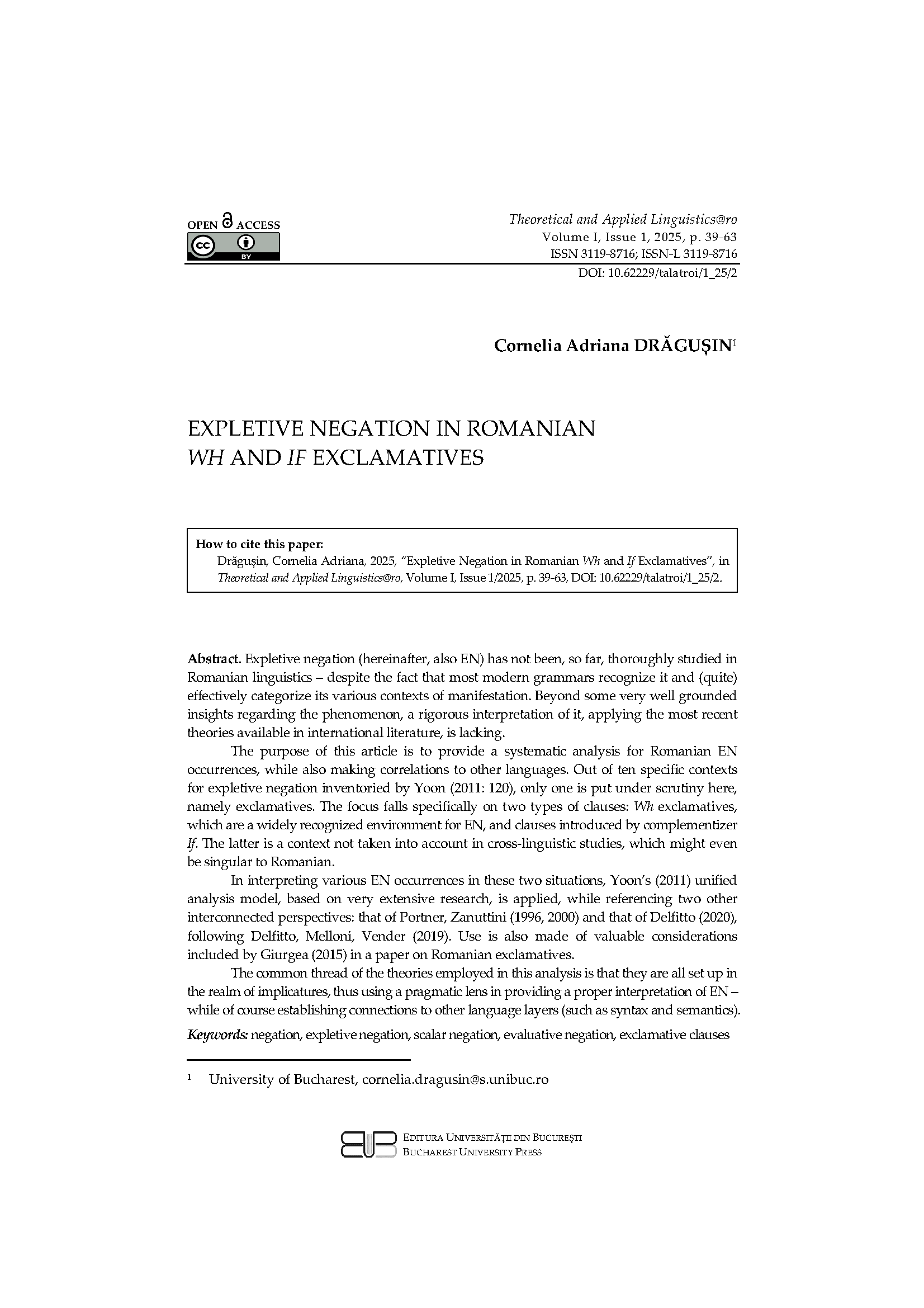
EXPLETIVE NEGATION IN ROMANIAN WH AND IF EXCLAMATIVES
Abstract
Expletive negation (hereinafter, also EN) has not been, so far, thoroughly studied in Romanian linguistics – despite the fact that most modern grammars recognize it and (quite) effectively categorize its various contexts of manifestation. Beyond some very well grounded insights regarding the phenomenon, a rigorous interpretation of it, applying the most recent theories available in international literature, is lacking. The purpose of this article is to provide a systematic analysis for Romanian EN occurrences, while also making correlations to other languages. Out of ten specific contexts for expletive negation inventoried by Yoon (2011: 120), only one is put under scrutiny here, namely exclamatives. The focus falls specifically on two types of clauses: Wh exclamatives, which are a widely recognized environment for EN, and clauses introduced by complementizer Expletive negation (hereinafter, also EN) has not been, so far, thoroughly studied in Romanian linguistics – despite the fact that most modern grammars recognize it and (quite) effectively categorize its various contexts of manifestation. Beyond some very well grounded insights regarding the phenomenon, a rigorous interpretation of it, applying the most recent theories available in international literature, is lacking.
The purpose of this article is to provide a systematic analysis for Romanian EN occurrences, while also making correlations to other languages. Out of ten specific contexts for expletive negation inventoried by Yoon (2011: 120), only one is put under scrutiny here,
namely exclamatives. The focus falls specifically on two types of clauses: Wh exclamatives, which are a widely recognized environment for EN, and clauses introduced by complementizer If. The latter is a context not taken into account in cross-linguistic studies, which might even be singular to Romanian. In interpreting various EN occurrences in these two situations, Yoon’s (2011) unified analysis model, based on very extensive research, is applied, while referencing two other interconnected perspectives: that of Portner, Zanuttini (1996, 2000) and that of Delfitto (2020), following Delfitto, Melloni, Vender (2019). Use is also made of valuable considerations included by Giurgea (2015) in a paper on Romanian exclamatives. The common thread of the theories employed in this analysis is that they are all set up in the realm of implicatures, thus using a pragmatic lens in providing a proper interpretation of EN – while of course establishing connections to other language layers (such as syntax and semantics). -
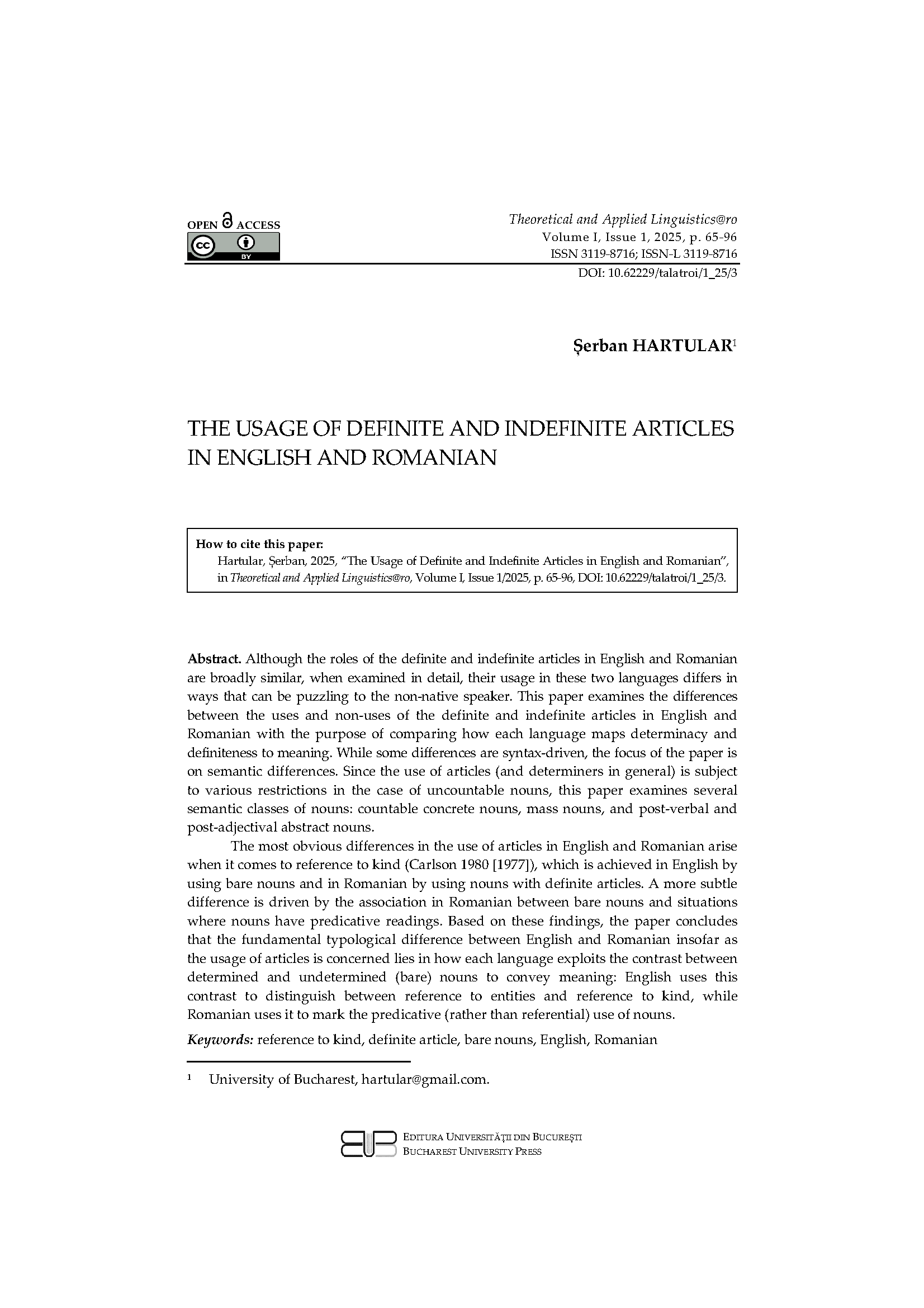
THE USAGE OF DEFINITE AND INDEFINITE ARTICLES IN ENGLISH AND ROMANIAN
Abstract
Although the roles of the definite and indefinite articles in English and Romanian are broadly similar, when examined in detail, their usage in these two languages differs in ways that can be puzzling to the non-native speaker. This paper examines the differences between the uses and non-uses of the definite and indefinite articles in English and Romanian with the purpose of comparing how each language maps determinacy and definiteness to meaning. While some differences are syntax-driven, the focus of the paper is on semantic differences. Since the use of articles (and determiners in general) is subject to various restrictions in the case of uncountable nouns, this paper examines several semantic classes of nouns: countable concrete nouns, mass nouns, and post-verbal and post-adjectival abstract nouns.
The most obvious differences in the use of articles in English and Romanian arise when it comes to reference to kind (Carlson 1980 [1977]), which is achieved in English by using bare nouns and in Romanian by using nouns with definite articles. A more subtle difference is driven by the association in Romanian between bare nouns and situations where nouns have predicative readings. Based on these findings, the paper concludes that the fundamental typological difference between English and Romanian insofar as the usage of articles is concerned lies in how each language exploits the contrast between determined and undetermined (bare) nouns to convey meaning: English uses this contrast to distinguish between reference to entities and reference to kind, while Romanian uses it to mark the predicative (rather than referential) use of nouns. -
VOCATIVES ON THE CLAUSAL SPINE: THE STATE OF THE ART
Abstract
This paper provides a critical overview of the formal proposals that attempt to capture the mechanism by which vocatives relate to the clause structure. Briefly, all the studies agree that vocatives merge in the clause in response to a trigger, namely a probing [addressee] feature. However, the studies diverge when it comes to the location of this probing feature and the implementation of its syntactic checking. Crucially, while recognizing the considerable progress the theory has made so far on this issue, this overview also reveals the areas that still pose challenges for all the current studies, and for which further research is needed.
Discursive Strategies in Context
-

MOMENTS AND THEIR MEN: METAPHOR AND ANALOGY IN FACEWORK
Abstract
Offences have negative effects on the public image of the offended party and on the expressive order of the verbal exchange in which they occur. Taking the Goffmanian interchange as a model, the article analyses several interactions in which participants process a possible offence with the help of a particular device consisting of source analogues, in order to neutralize these effects. Participants first map the first source (metaphor) to check whether it correctly identifies the pragmatic value of the offence. Then, they map the second source (analogy) to jointly discover the target configuration. The target – the specific conversational situation in which the offence occurred, along with the resulting balance of power between the interlocutors – is treated as unknown or less well-known than the source. The target is protean and mobile, and may draw in or remove past elements of the ongoing conversation.
The participants in the verbal interactions analysed have a high degree of reflexive awareness, as evidenced by the fact that they propose and reject ideas, formulate new proposals, develop them, and ultimately agree on the pragmatic value to be attributed to a particular utterance that is perceived as potentially offensive. The type of moment we are concerned with in this study does not have the disadvantages of excuses, which impose a burden on both the person asking and the person receiving. With this device, participants can effectively negotiate the meaning of an utterance. It also has the ability to build and develop social relations between participants. Mapping the correspondences between the source and the target reveals that there are reciprocal relations between the participants – they are together in the analogy scenario and the differences between the offender and the offended disappear. -

VIRTUȚI EXPRESIVE ÎN OPERA LUI ION SIMIONESCU
Abstract
Ion Th. Simionescu (1873-1944) stands as one of Romania’s foremost contributors to the development of the natural sciences, distinguished not only by his scientific research but also by his remarkable literary artistry. The present study aims to elucidate several
enduring expressive features that characterize scientific writing prior to the outbreak of the Second World War, with particular focus on Simionescu’s extensive body of work. His prolific output, encompassing over 1700 publications in Romanian, French, and German, ranges from academic treatises to popular science literature, pedagogical texts, and literary essays.
While his scientific writings reflect the precise, methodical style typical of the 19th-century scientific revolution, his popular science works are distinguished by vivid imagery, narrative dynamism, and a rich tapestry of cultural references. Drawing parallels with
influential figures such as Eduard Suess, Alexander von Humboldt, and Jean-Henri Fabre, this article situates Simionescu within a tradition of scholar-writers who seamlessly fuse rigorous scientific inquiry with aesthetic expression. Simionescu bridges scientific discourse and artistic eloquence, employing devices such as dramatized prose, metaphor, amplification, and folkloric motifs to render complex natural phenomena both accessible and engaging for a broad audience. His writings reflect a deep cultural erudition, integrating mythological, religious, folkloric, and literary allusions to enrich scientific exposition. Furthermore, the study highlights compositional continuities between Simionescu’s works and those of prominent European scientists, underscoring shared rhetorical and stylistic strategies rooted in Enlightenment ideals. Despite his monumental contributions, Simionescu’s legacy remains insufficiently explored within contemporary scholarship. His oeuvre exemplifies a vision of science as not merely an accumulation of empirical data, but as an aesthetic and cultural enterprise, deeply intertwined with humanistic values. -

PREMISELE UNEI DESCRIERI ACUSTICE A RÂSULUI ÎN DISCURSUL SPONTAN. DELIMITĂRI TIPOLOGICE ȘI TERMINOLOGICE
Abstract
Laughter is a complex, multimodal phenomenon that has been investigated across a variety of disciplines and documented for multiple languages. Yet for Romanian, empirical research is scarce and no detailed acoustic description is currently available.
This article aims to address this gap by offering the first integrated theoretical, terminological, and acoustic account of laughter in spontaneous speech based on Romanian data. Building on the classification proposed by Truong, Trouvain, Jansen (2019), the hierarchical structure of laughter (i.e., episode, bout, subbout and pulses) is described. The study showcases a wide range of laughter forms, from speech-synchronous events, speech-laugh and smiled speech, to voiced and unvoiced outputs produced with either an ingressive or egressive airflow.
Each type is illustrated with examples from the Ro-Phon corpus, with corresponding audio files accessible via the phonic.ro platform. The significance of this present work lies in two key contributions. First, it provides the foundational terminology and typology needed for a systematic study of laughter in Romanian. Second, it offers high-quality acoustic information that will facilitate cross-linguistic comparisons, allowing Romanian data to be directly contrasted with findings from other languages. It is hoped that this first account will stimulate further research on laughter in Romanian, fostering comparative and interdisciplinary studies that shed light both on language-specific as well as languageindependent characteristics of this complex phenomenon. -

EXPLORING POLYPRAGMATICALIZATION PATTERN: THE CASE OF ROMANIAN SPEECH VERBS A ZICE AND A SPUNE
Abstract
The article aims to illustrate the theoretical framework of polypragmaticalization, which refers to the process by which a lexical or grammatical form can give rise to multiple units with pragmatic and discourse–level meaning (Dostie 2001, 2004; Buchi 2004). As a case study, it examines the Romanian speech verbs a spune and a zice ‘to say’.
After outlining their syntactic and semantic properties – which reveal broadly similar behaviour – the article identifies several fundamental differences between the two lexemes. These distinctions are: (i) frequency of use (a zice was more common in Old Romanian, whereas a spune is more frequently used in contemporary Romanian), (ii) a broader and more varied semantic range (in favour of a zice), and (iii) a stronger tendency to occur in idiomatic or phraseological expressions (again, more strongly oriented toward the contextual discourse level, in the case of a zice).
These contrasts are likely due, in part, to the phonetic structure of a zice, which is shorter, easier to pronounce, and more etymologically transparent. More significantly, however, the two verbs differ in terms of subjectivity: a spune is perceived as more objective, while a zice tends to carry a subjective nuance. This subjectivity has played a key role in the development of a zice into a wide range of discourse and/or pragmatic markers, both in its original form and in derived expressions such as cică (< [se zi]ce + că) ‘it is said + that’, carevasăzică ‘that is to say’, știi ce zic ‘you know what I mean’, and others. Typologically, similar polypragmaticalization processes – particularly the shift from speech or movement verbs to discourse and/or pragmatic markers – have been documented in various languages, such as Spanish or Min, a variety of the Chinese language (Chappell 2017; Ruiz-González 2021). For Romanian, relevant studies include Popa (2007), Barbu (2008a, b), Prelipcean (2015), and Botez Stănescu (2021).
Romanian Vocabulary across Time and Registers
-

DIN NOU DESPRE TERMINOLOGIA MATEMATICĂ ÎN SECOLUL AL XIX-LEA AGAIN ON THE MATHEMATICAL TERMINOLOGY IN THE 19TH CENTURY
Abstract
In this paper the author continues the study of the terminology of mathematics in the 19th century, focusing on an investigation of the terms belonging to two of its subfields, namely arithmetic and algebra. In this respect, the lexical inventory is made up of 65 dictionary entries recorded in Ion Costinescu's Vocabularu romano-francesu [The Romanian-French Vocabulary] (Bucharest, 1870), of which 40 terms are arithmetical terms, 19 terms belong to algebra, and for 6 terms, the meaning simultaneously covers both algebraical and the arithmetical uses and, in addition, extends to the field of geometry. Their analysis from a morphological, semantic and etymological point of view enables accurate remarks concerning both their dynamics and their status in older and contemporary Romanian.
-
TERMENI ASTRONOMICI ÎN DICȚIONARUL LUI IOAN D. NEGULICI (1848) ASTRONOMICAL TERMS IN THE DICTIONARY OF IOAN D. NEGULICI (1848)
Abstract
The “Alexandru Philippide” Institute of Romanian Philology in Iași hosts extensive interdisciplinary historical research on Romanian astronomical terminology. The Dictionary of Astronomical Terms: Phenomena, Cosmic Objects and Constellations (DAFOC, letters A-K, first edition 2023, revised edition 2024), initiated and coordinated by Cristina Florescu, is one of the research results, achieved as part of an exploratory research project funded between 2021 and 2023. DAFOC is a historical dictionary, which deals linguistically, in diastraty (popular and scientific), with specialized terms in the field of astronomy. The scientific component of this terminology has a pronounced neological character that manifests itself in different stages of the Romanian language. The Romanian printed lexicography of neologisms debuted in 1848 with The Romanian Vocabulary of all the ancient words accepted so far in the Romanian language, and of all those that are to be accepted from now on, and especially in the sciences, compiled by Ioan D. Negulici. This dictionary includes scientific terms from various fields (medicine, astronomy, politics, etc.). DAFOC records terms with (first)
lexicographical attestations from Negulici’s dictionary. First attestations have been recovered for: Balanța ‘the Balance’, boreal (as a standalone adjective, not involved in phrases), and corp ceresc ‘celestial body’, but also lexicographic attestations for terms such as: aberație ‘aberration’, astru ‘star’, echinocțial (in the form echinopțial) ‘equinoctial’. In addition to these, the following are also recorded in the 1848 dictionary: latitudă/latitudine ‘latitude’, Luceafăr ‘morning star’ (s.v. Lucifer), Mercur ‘Mercury’, etc., in total approximately 175 astronomical terms. The Romanian Vocabulary from 1848 represents a consistent lexical source for DAFOC through the variety of forms, the lexicographic confirmation of some neological terms, the antedating of some first attestations, and the lexical novelties. -

UN TERMEN VECHI ASOCIAT CONCEPTULUI DE „AUTORITATE”: STĂPÂN AN OLD TERM RELATED TO THE CONCEPT OF “AUTHORITY”: STĂPÂN
Abstract
The purpose of this article is to synthesize issues related to the history of the ancient Romanian term, stăpân, associated with the concept of “authority”. Its importance in Romanian vocabulary is proved by early written attestations, its frequency and dialectal spread, the large number of derivatives created, and its status as the center of numerous phraseological units. Although the possible belonging of Rom. stăpân to the Thraco-Dacian substratum has been demonstrated, based on its relationships with equivalent words in Albanian and other Indo-European languages, this etymology does not appear in the dictionaries of the Romanian Academy (DLR, DEX). It is thus proposed that this issue should be reconsidered from the perspective of the solutions proposed in this study in which the autochthonous origin of this common noun is solidly argued. Starting from the treatment of the lexicographical entry stăpân in DEX and DLR, the meanings will be established on the basis of which the association of the notion of authority with the term stăpân “master” is justified.
-
CÂTEVA CONSIDERAȚII DESPRE STIL ȘI DINAMICA LEXICULUI ROMÂNESC ACTUAL A FEW REMARKS ON STIL AND THE DYNAMICS OF PRESENT-DAY ROMANIAN VOCABULARY
Abstract
The present paper aims at investigating – from a multidisciplinary (etymological, semantic, functional) perspective – the impact of English on some terminologies formally and semantically related to the concept of style (such as clothing, hairdressing and cosmetics). The analysis is based on a corpus including simple, compound and phrasal terms selected from the online media and websites on the Internet.
Two major categories of specialized terms are taken into consideration: English borrowings (still looking foreign in form) and different types of calques (structural, phraseological, semantic) reproducing English models by means of Romanian words, mostly of French origin. It is worth noting that most of these neologisms are not listed in the general dictionaries of contemporary Romanian, despite their increasing frequency not only in the jargon of experts, but also in journalese, advertising, and the everyday language of social networks.
In the end, the study briefly presents from a functional perspective the discursive functions performed in specialized texts, in journalese and in advertising by the “necessary” vs “superfluous” Anglicisms included in the “hybrid” family of the word stil.
Books, Voices, Perspectives
-

Book Review of: MAJID KHOSRAVINIK (ed.), Social Media Critical Discourse Studies London/New York: Routledge, 2023, 111 p., ISBN 9781032443034
Abstract
Volumul editat de Majid KhosraviNik reunește șase articole publicate în revista Critical Discourse Studies (volumul 19, numărul al doilea) în 2022. Reeditarea acestora în forma de volum unitar tematic și metodologic reprezintă o oportunitate pentru familiarizarea cititorilor cu noi direcții interdisciplinare dezvoltate pentru înțelegerea discursurilor media contemporane. Fiecare articol este însoțit de bibliografie. Volumul prezintă o notă asupra autorilor, o scurtă introducere semnată de editor, precum și un indice reunit de autori și materii.
-

Book Review of: MIHAELA MANCAŞ, Dicţionar de stilistică: poetică, retorică, naratologie, versificaţie, ediţia a doua Bucureşti: Editura Spandugino, 2023, 295 p., ISBN 630-6543-16-8
Abstract
Lucrarea de faţă reprezintă un dicţionar fundamental, apariţia lui fiind binevenită în contextul în care, în spaţiul lingvistic românesc, există o singură lucrare de referinţă dedicată terminologiei de stilistică şi poetică: Mica enciclopedie a figurilor de stil, publicată în 1975, de Gh.N. Dragomirescu. Alături de aceasta, mai există Dicționarul de ştiințe ale limbii (DSL), apărut în trei ediţii (1997, 2001, 2005), avându-i ca autori pe Angela Bidu-Vrănceanu, Cristina Călăraşu, Liliana Ionescu-Ruxăndoiu, Mihaela Mancaş, Gabriela Pană Dindelegan şi care, pe lângă termeni lingvistici şi gramaticali, cuprinde şi numeroase articole dedicate terminologiei de stilistică şi poetică.
-
Book Review of: ANDRA VASILESCU, MIHAELA-VIORICA CONSTANTINESCU, ARIADNA ȘTEFĂNESCU, ȘERBAN HARTULAR, Insights into Romanian Political Discourse Newcastle upon Tyne: Cambridge Scholars Publishing, 2024, 511 p., ISBN 1-0364-1533-3
Abstract
As stated in the Editorial at the outset, this volume constitutes the first comprehensive scholarly effort to examine Romanian political discourse tailored for an international readership. It analyzes a wide array of political discourse genres – including parliamentary and presidential debates, political programs, media talk-shows and ceremonial speeches, while also addressing public responses manifested through protest slogans, memes, editorials and online commentary. Laying emphasis on current discursive practices with occasional historical references, the volume fosters interdisciplinary dialogue across fields such as linguistics, communication studies, anthropology, psychology and political science.
-
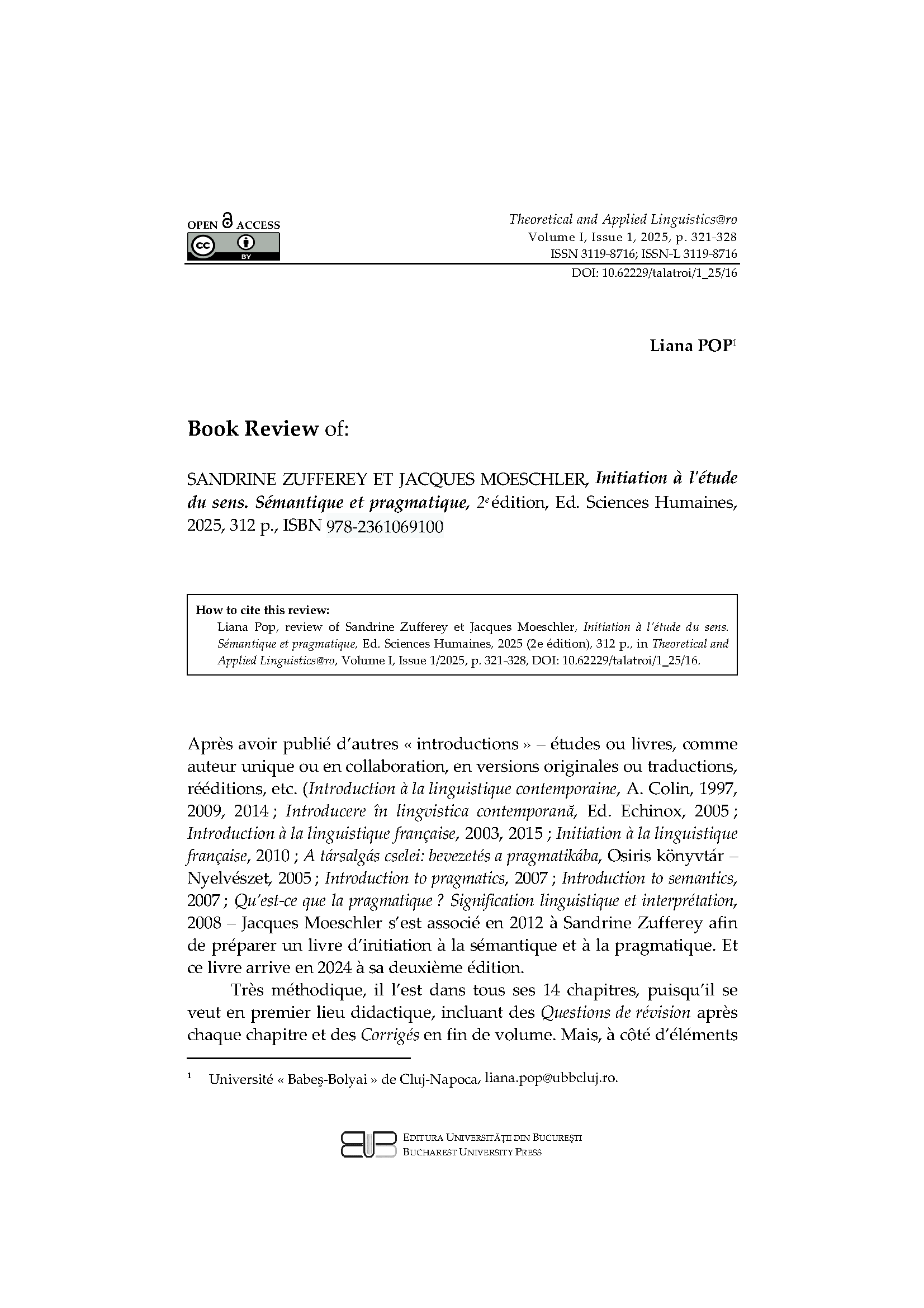
Book Review of: SANDRINE ZUFFEREY ET JACQUES MOESCHLER, Initiation à l'étude du sens. Sémantique et pragmatique, 2e édition Ed. Sciences Humaines, 2025, 312 p., ISBN 978-2361069100
Abstract
Après avoir publié d’autres « introductions » – études ou livres, comme auteur unique ou en collaboration, en versions originales ou traductions, rééditions, etc. (Introduction à la linguistique contemporaine, A. Colin, 1997, 2009, 2014 ; Introducere în lingvistica contemporană, Ed. Echinox, 2005 ; Introduction à la linguistique française, 2003, 2015 ; Initiation à la linguistique française, 2010 ; A társalgás cselei: bevezetés a pragmatikába, Osiris könyvtár – Nyelvészet, 2005 ; Introduction to pragmatics, 2007 ; Introduction to semantics, 2007 ; Qu’est-ce que la pragmatique ? Signification linguistique et interprétation, 2008 – Jacques Moeschler s’est associé en 2012 à Sandrine Zufferey afin de préparer un livre d’initiation à la sémantique et à la pragmatique. Et ce livre arrive en 2024 à sa deuxième édition.